
WELCOME!
My name is Frances Marcellin and I'm a British illustrator and artist living in France.
With a background in film and national journalism, my research-led practice uses art as a narrative language to explore society- and humanitarian-centered stories with empathy and social awareness.
While working on commissions for clients, I'm also studying part-time for an illustration degree with the Open College of the Arts and a mum to four incredible kiddos.
To view a categorised selection of my artwork, visit the Work section of this site or scroll down to see some of the latest goings on.
To view my AOI (Association of Illustrators) portfolio please click here.
_edited_edited_jp.jpg)
A small selection of the media clients I've worked with:



Find my cartoons here:

Also seen in:

LATEST NEWS
I'm so excited to announce that I've just launched a wedding illustration business here in France to help couples and their guests remember their magical day forever.
There are three services:
1. Live wedding guest illustrations
2. Bespoke venue illustrations
3. Original abstract canvas paintings - started by me and then created with and by the guests.
I'm based near Castres, in the Tarn, so I work across Occitanie and South West France.
I'll have a dedicated website soon, but for now you can read more here and for the French version, please visit this page.
This is an example of how I work, sketch first, then ink (using my TWSBI fountain pen and Micron fineliner if required), then ink wash - delicately applying my favourite kind Platinum Carbon Ink.


I can sketch six or more people per hour in this pen and ink style with ink wash. Guests receive an A5 artwork (sealed in a protective sleeve with a gold heart sticker) that looks beautiful in a standard frame - see below.

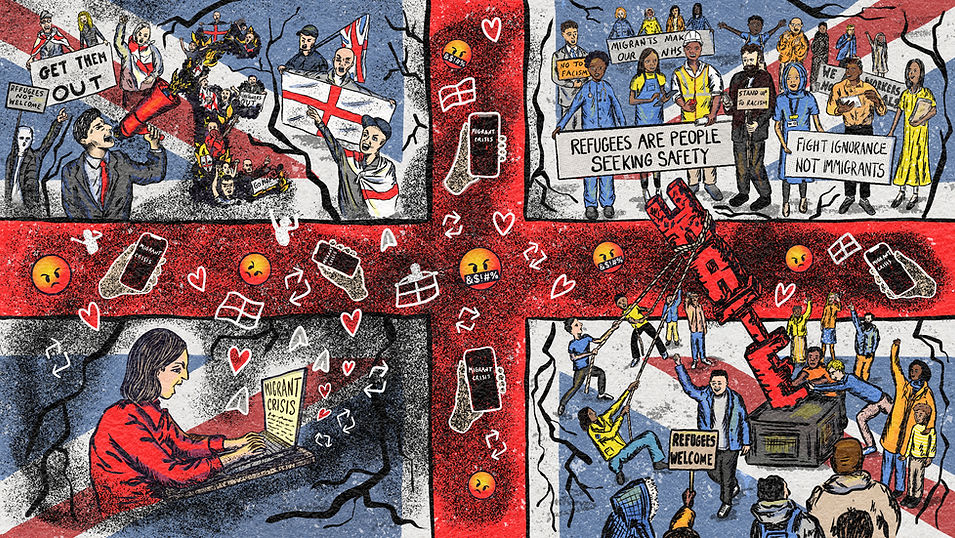
I've recently had the privilege of working with The Bureau of Investigative Journalism on the branding illustrations for The Hate Economy, a vital journalism project dedicated to exposing those who profit from inciting hate and division in the UK through robust, fact-based reporting.
I worked with the team to design and produce one 16:9 header image as shown above plus five editorial illustrations which are being applied across the following platforms: website, news section, crowdfunder campaign, social media (including information videos) and newsletters.

The Bureau has already uncovered how a far-right political party used the AI-generated rapper Danny Bones to spread its message and how overseas content creators profited from producing anti-immigration videos. The Hate Economy will build on investigations like these while giving voice to the people and communities most affected by hate.
The crowdfunder is now live, and every donation will be matched up to £20,000, doubling the impact of every contribution.


My illustration Stop the Genocide in Gaza was longlisted by the World Illustration Awards 2026 in the New Talent / Editorial section. I'm so grateful to the judging panel for deeming it worthy. Read more here in my Journal, on my Instagram and my Facebook page.
ORIGINAL PAINTINGS
I love to create postcard and ACEO (3.5"x2.5") original paintings of the landscapes around me in France – those that inspire me every single day. I feel like I'm painting my joy into a little canvas and then sending it to a loving home. All my interactions with buyers have been so positive and I'm happy to be developing my art in this area, it feels like I found a wholesome creative corner in an increasingly fragmented world.
I regularly sell pieces on eBay (usually auctions): Click here to view listings and just opened an Etsy shop: FrancesMarcellinArt.
These are some of the ACEO and postcard-sizes pieces I've sold :


This is an Instagram reel I made to show some of my process making postcard and ACEO original paintings of France. It downloaded without music though, so to see the version with original audio go here.


This is one of my recent postcard-size (A6) pieces for sale - inspired by the chalets in Gruissan where the film Betty Blue was filmed. Read more or buy at my shop Frances Marcellin Art & Illustration or on eBay.
DEGREE SPOTLIGHT
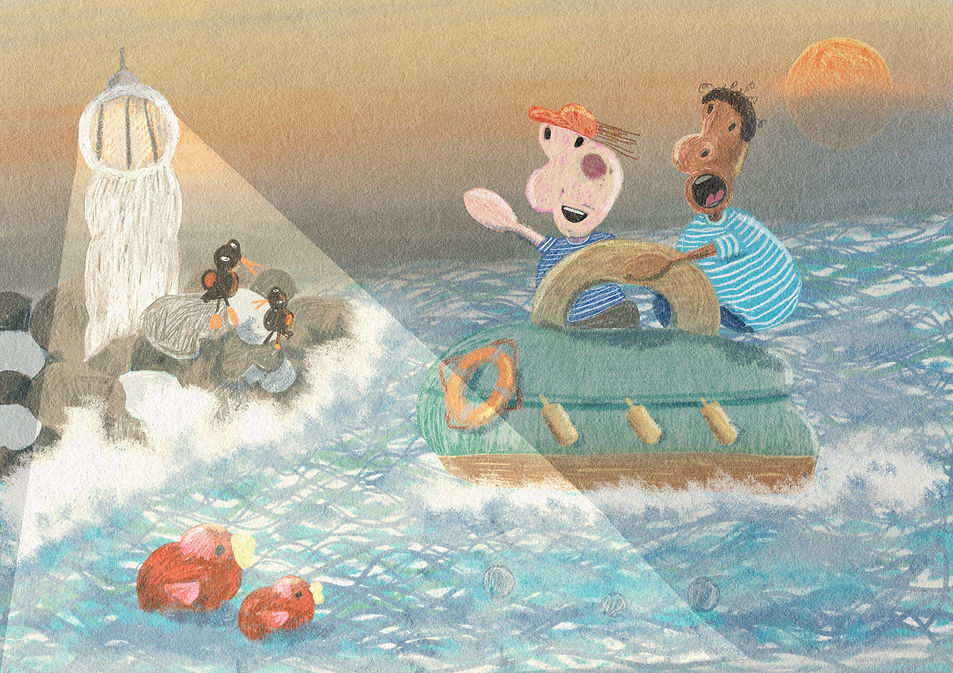
This illustration started its life as a mug and scissors on my desk!
in an 'abstraction' module as part of my illustration degree (with the OCA), we were tasked with drawing around and cutting out eight objects on our desk (such as scissors, a mug and tape) and then combining them to make other forms.
We then had to create two compositions from the shapes and this is one of my final pieces.
At first I thought this process would be restrictive, but finally I found it incredibly liberating as I created in a way that took me right out of my comfort zone. It really shook up my style and process which I found super exciting. Read more about the process here in my journal.
LIVE ILLUSTRATION

Are You Looking for Live Event Illustration and Graphic Recording for Conferences in the UK, Europe or beyond?
I provide live event illustration and graphic recording for English-language conferences, summits, workshops and strategic events run by charities, NGOs and organisations across Europe and the rest of the world.
Working in real time - and supported by 15 years in reporting and editing roles as a freelance journalist - I listen closely and visually capture key ideas, messages and discussions. This enables audiences to remember and share the most important aspects of the conference.
Based in France and working internationally, I support events across Europe and the UK, both on site and remotely.
To find out more about the live event illustration and graphic recording service I provide, visit the dedicated Live Illustration section on my website.
EDITORIAL ZONE
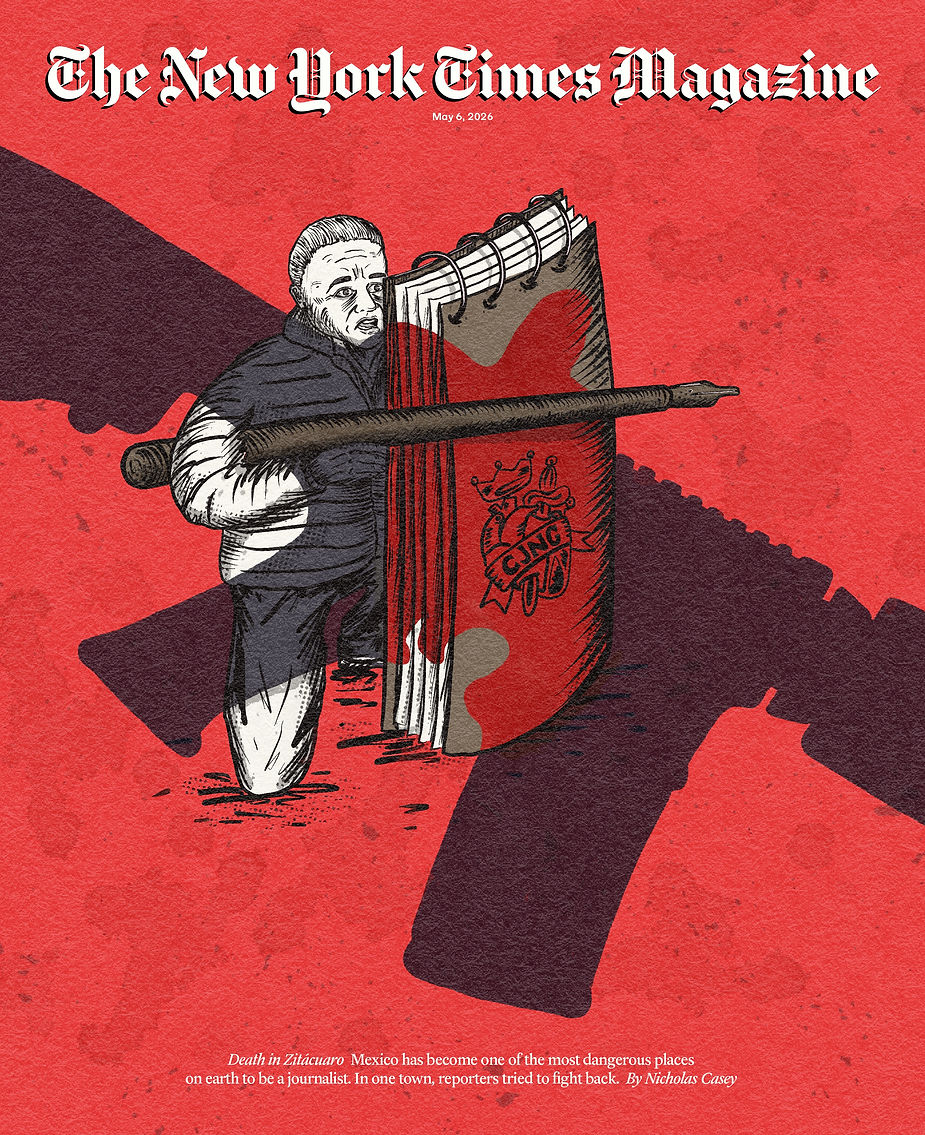
I recently created this cover for 'The New York Times Magazine' as part of an editorial course with Inkygoodness in collaboration with NYT designer Victoria Escobar. The story covered the danger of being a journalist in Mixico, particularly focusing on the life of Armando Linares Lopez, who was fatally shot by the cartel. He said he felt is only defence was a pen and a notebook, which inspired the idea for my illustration.

This illustration was based on a mock New Scientist brief as part of Inkygoodness' editorial course. Read the case study here.

Personal work for 'petit journal' ALBERT, a French newspaper for children aged 9-14.
For ALBERT, illustrators create a surreal-looking cover image inspired by its major stories, which are then cropped to accompany the articles inside.
I decided to try my hand at No. 147 in which the following subjects were covered:
Why the counterfeit goods market is growing.
What happens to radioactive waste.
How glaciers hold 'ice memories' of our planet.
Nelson Mandela's tenacious fight for equality.
Smaller stories also represented involved Burkina Faso, Dominican Republic and Japan.
ILLUSTRATING FOR CHILDREN
Visit my folio on the Association of Illustrators site for my updated portfolio and for the full picture check out the 'Work' section of this site and explore by category.
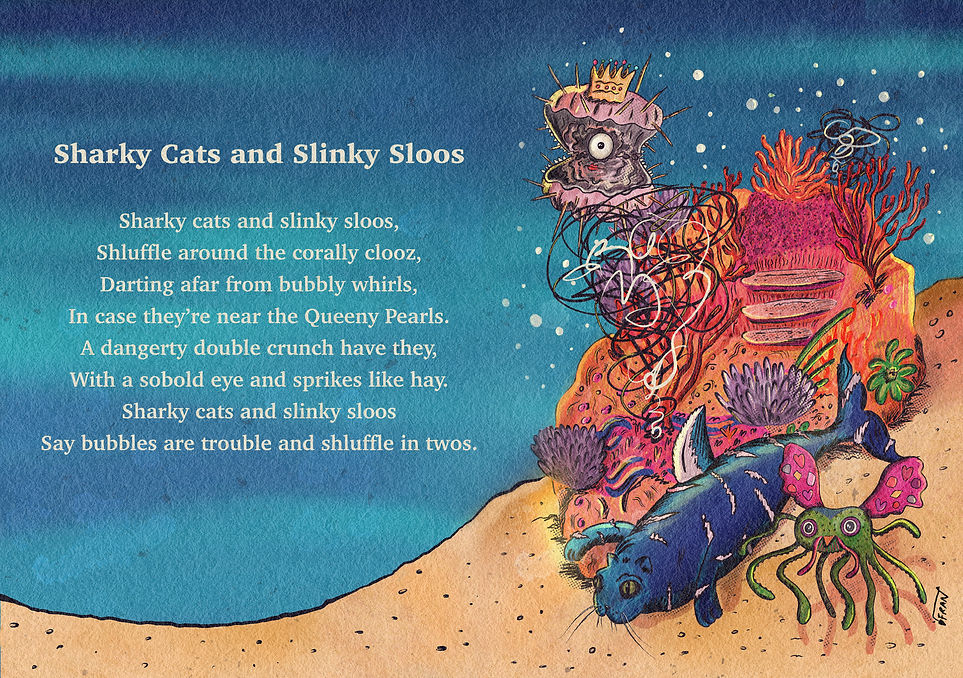
One of my long-term goals is to become a children's author and illustrator. I created the Sharky Cats and Slinky Sloos poem and artwork for my illustration degree coursework. We were tasked with being inspired by, or writing our own, nonsense poem, like Lewis Carroll's Jabberwocky. I decided to write mine and then set about creating the characters. I absolutely loved working on this project and in the future hope to create a whole book based around nonsense poems and world building, it is definitely one of the most exciting projects I've ever worked on and I was delighted with the result (as was my tutor, which made me even more pleased with the outcome).

Created for The Imagined Book Cover challenge on Instagram, which was founded by Monty Lee - #theimaginedbookcover2025. In my version, Eleanora is a giraffe with allergies and, as a result, has a slight problem with loud, windy and snotty sneezes. Needless to say whenever she has a sneeze attack it affects all of her jungle friends. At first they get pretty angry with her, but in the end they grow to understand how they can help her manage her troublesome symptoms in the kindest, cutest ways.

Daisy Sweetapple Lives Next Door was designed for The Imagined Book Cover challenge on Instagram, which was founded by Monty Lee - #theimaginedbookcover2025. The monkey is based on one of my childhood toys, Sam, whose hands were stitched together with cotton thread so that I could walk around with his arms around my neck. Is Daisy's monkey real or her own little Sam? I guess you'd have to read the story to find out exactly what goes on next door.

Personal work for Youpi Doc, a French magazine aimed at children who I would very much like to illustrate for in the future. I created this cover image, based on the magazine's theme of 'Pourquoi faut-il se laver?' (why do we have to wash ourselves) and created my own version. I copied their magazine title and cover elements to make it look realistic, but, as explained, this isn't the official cover, it's my design based on
their theme.
LET'S CONNECT
I'd love to discuss how we can work together, reach out to me by email at frances@francesmarcellin.com - thank you.

This is happens way too often in my studio!
